Monday, November 19, 2012

DMZ - Past Connecting Present


“Those who cannot remember the past are condemned to repeat it.” (George Santayana, a poet, philosopher and cultural critic) The DMZ or the Demilitarized Zone is one of the few places where people are unable to go, so the natural flora and fauna is able to flourish. 

This place remains untouched and unharmed despite the fact that it is the most heavily guarded and militarized places in the world. The DMZ is also the site where Korean Peninsula is divided into two. 
Peaceful...
During the Korean War, a stalemate occurred and a demarcation line was drawn along the 38th parallel north as part of the Armistice Agreement of July 27, 1953. Owing to the fact that a Peace Treaty has yet to be signed, South Korea and North Korea are technically still at war

Landmines and many unexploded ordnances are scattered at the DMZ, making it uninhabitable. It is pitifully sad that after so many years, both nations, though similar in language and race, are nevertheless still tragically separated due only to differences in ideology. 

Inje (인제군)


This place is located in Gangwon Province. Due to its proximity to North Korea, Inje has the lowest population density in South Korea. Hence, unpolluted air combined with fresh clear water can be found in this underdeveloped area. 

This region provides a great escape from the hustle and bustle of city life. For drinkers, this is also the best place to enjoy the delicious traditional Makgeolli made from the freshest ingredients (Dang! I did not take any pics!).   
Getting There: A five-hour express bus ride from Daegu
Accommodation: 50,000 Won per night for double room or 80,000 won per night for 10-person dormitory 

Did you see my name?
Our lodging was a sparse, yet comfortable, Korea DMZ Peace-Life Valley Education and Training Center (한국DMZ평화생명동산교육마을). Long name huh? Located between two main tourist attraction sites, it is a strategic spot for further exploration of the area. 

Each meal is around 4,500 Won and most of the ingredients from the dishes are from the region or from the farm outside the center. The first place I visited was the Eulji Observation Platform.

Eulji Observation Platform (을지전망대)
Eulji Observation Platform
No GPS signal!
Entry Fee: 2,500 won per adult (Fee for Fourth Incursion Tunnel included) and registration at the Yanggu Unification Center is needed prior to visit. Visit http://www.ygtour.kr/ for more info

This is the most tightly guarded area in this region. Positioned just over 1 km from the North Korean side, we had to pass through several military checkpoints. This platform was built on the ridge of Gachilbong Peak, which is over 1,049m above sea level. 

Directly beside it, is the “Punch Bowl”, a fertile valley aptly named as it resembles a punch bowl. Innocent as it may sound, this is the site where many lives were lost during the tragic Korean War.      

On a clear day, the North Korean army can be seen from here. Unfortunately, during my trip, the weather was very misty and visibility was extremely poor. I had to make do with listening to the video presentation followed by a brief explanation about the area. Telescopes are also available. 

Due to the relative isolation from the city, the air is cool and fresh as it is located at the peak of the mountain. The rules there are simple—no photographing and strict adherence to guidelines stipulated by the army. It was an exhilarating   experience for me to be in the DMZ zone.

Fourth Incursion tunnel (제4땅굴)

This tunnel was discovered on the 3rd of March 1990. It measures over 2km in length and is buried 145m below the ground. For the claustrophobics, this is not a place to venture because the tunnel at the end is very narrow. The height of the tunnel is a mere 1.7m high and it measures 1.7m in width. 

As it was raining outside, we were wet in the tunnel from droplets of water falling on our heads. After a walk in the tunnel, I decided to take a ride in a mini train as we approached the deeper end of the tunnel. My butt got wet sitting on the damp train.... wth...


An army personnel was assigned to guide our group. He explained the intention and strategic values behind the construction of the tunnel by the North Korean army. The tunnel was built manually, using spades and explosives to bore through the hard rocks. 

What is so astounding was that after so many years of blasting rocks on South Korean territory, a railway line was also built— unnoticed and undetected by South Korea! Outside the tunnel are relics left behind from the Korean War. 

There are tanks, armored personnel carriers and rusting reconnaissance planes, located side by side, as a reminder of the many lives lost during this tragic war. There, I posed for pictures, pretending to be a pilot, an army officer and tourist with crazy posing ideas.
Nice place for countryside experience...
Due to time constraints, we had to call it a day after the visit to both sites. The trip back was accompanied by military personnel who checked our cameras to ascertain whether we had taken any prohibited photos. We had dinner at the Korea DMZ Peace-Life Valley Education and Training Center

There was a joke among our group that as the DMZ is devoid of female presence, (No kidding!) it is therefore appropriate for soldiers, retirees and wild animals. I observed that the entertainment places for the army are PC rooms, restaurants and billiard centers.  

Dutayeon Falls (두타연)
Getting there: Since the pond is located north of the Civilian Control Line, application to the military authorities must be submitted two days ahead of your planned visit and requisite approval must be obtained. No personal trip is allowed and only a group of four persons or more can enter the site. Admission fee is 2,000 won per adult

Dutayeon Valley is said to be the area where freshwater lenok fish thrive in the crystal clear valley streams. Because of its isolation, the ecological habitat of its flora and fauna around the valley is well preserved. Duta means living in peace and self-control without worrying about daily affairs such as which clothes to wear, food to eat and other nitty-gritty issues. Therefore, the name fits very well with the beauty and serenity of this uncontaminated mountain valley. 
At the Dutayeon
Side Trip: Pyeonghwa (Peace) Dam
The Dutayeon Pond is fed by water from the Dutayeon Falls, a 10-meter high and 60-meter wide cascading waterfall that channels the water of the Suip Stream (수입천) into the pond. To reach the Dutayeon pond, I had to walk over a stream via the suspension bridge. It was a chilling experience as the bridge swung precariously with every step I took.

Inje is the perfect destination for adventure seekers, history enthusiasts and tourists seeking to escape the busy city life. I always believe life is full of uncertainties. As a foreigner, the DMZ is one of the places in Korea I yearned to go to for a long time. Hence I felt a sense of accomplishment that I had been to this place and witnessed the splendor of this historic location. It is my hope that the DMZ will always remain as it is— ecologically diverse, pristine and untainted. 

KNU Times!
(This was written for KNU Times, my university's English magazine. I am currently working since last semester there so life is pretty hectic at the moment. It was some sort of an achievement to me because I am the first foreigner since its first publication in 1963.)

Sunday, July 8, 2012

Korea.. A Hierarchical Society..


I do not deny that I have not been in Korea that long comparable to the likes of many people I knew. Up to now, I have stayed in Korea for around 4 years. However, from the moment I arrived to Korea, the first people I met was a Korean. 

At the beginning, I do not know there were any foreigners living in my university so my friends were mostly Koreans. It was tough but with time, I matured and now, I take each challenges as if I have another puzzle to be solved.


I like to observe people too.

So far, there's one thing I cannot adapt here-It is the Korean culture of hierarchy in almost every environment. Elders are always respected no matter they are right or wrong, sometimes even juniors kowtowing to them so as to obtain good impression from the superiors. 

I think I am exposed to more Westernized environment. I questioned seniors/elders if I felt I am right, I ask when am curious, I follow orders but not blindly. In Korea, it's very rare to see students asking questions in class, students questioning professors' conducts were unheard of and promotion based on ability is not as widely practiced as promotion based on age.

Of course, I still have Asian values in me.

The other day, while having dinner with Koreans and a Chinese- Everyone were older than me, so I used honorific like "저는 (jorh nen)" instead of a more friendly term like "나는 (nah nen)" and ended my sentence with a "-요 (yo)" as to comply with the Korean style of speaking to the elders. 


Bulgogi (불고기)

So after a while, the chief of the organization entered and like they were been struck by a lightning bolt on their asses, immediately everyone rises. I was already halfway munching my beloved 15,000 Won (13 USD) 불고기 (Bulgogi) and have no choice but to stand up so as not to be the odd ones out. Then, the other Koreans began to act like as if a King had just arrived. Drinks were ordered and the rest, well, I don't really care.

When I am old, I do not want people to agree with me if I am wrong. I do not want people to hesitate and give me a vague answer rather than a Yes or No. I do not want my junior to act and pretend to be nice when any seniors or me are around.

Respect I felt, is not a God given right and it has no relation with the age of a person. It has to be earned. It's just that I felt Korean's culture of hierarchy will be huge impediment for its future growth in a long run. 

I hope in years to come, Koreans will be true to themselves and not be pretending to be nice just because the elders are around. Not all Koreans were like that but unfortunately they are the minority.  


Thursday, July 5, 2012

Adventures at Yeosu - Yeosu Expo 2012

Yeosu Expo is being held in Korea from May 12 to August 12 this year. This exposition is aimed to allow the international community to understand the importance of conservation and the proper use of the ocean and coast resources. 

Not to forget, this exposition is also held to showcase the different cultures of the world and to strengthens Korean's international image as the host country.

  
Welcome to Yeosu Expo! 


With a huge numbers of pavilions being set up in a short time, it was a remarkable achievement for Korea. As a student staying in Korea, it would be a wasted opportunity if I did not attend this expo. So like most cash-strapped students, we try to go on budget (It is impossible though...). 

Unpredictable as my friends were, we decided to go to the exposition after deciding only two days before.

 
This is me! 


I love adventure and going to places with little planning. Usually, most of my trips were not planned but we have a list of where to go and what to try. 


Getting to Yeosu from Daegu is not difficult as it seems. Yeosu is located at the Southernmost of Korea and it takes less time (and cheaper) to travel from Daegu (in the middle of South Korea) to Yeosu than Seoul (northern part of South Korea) to Yeosu.


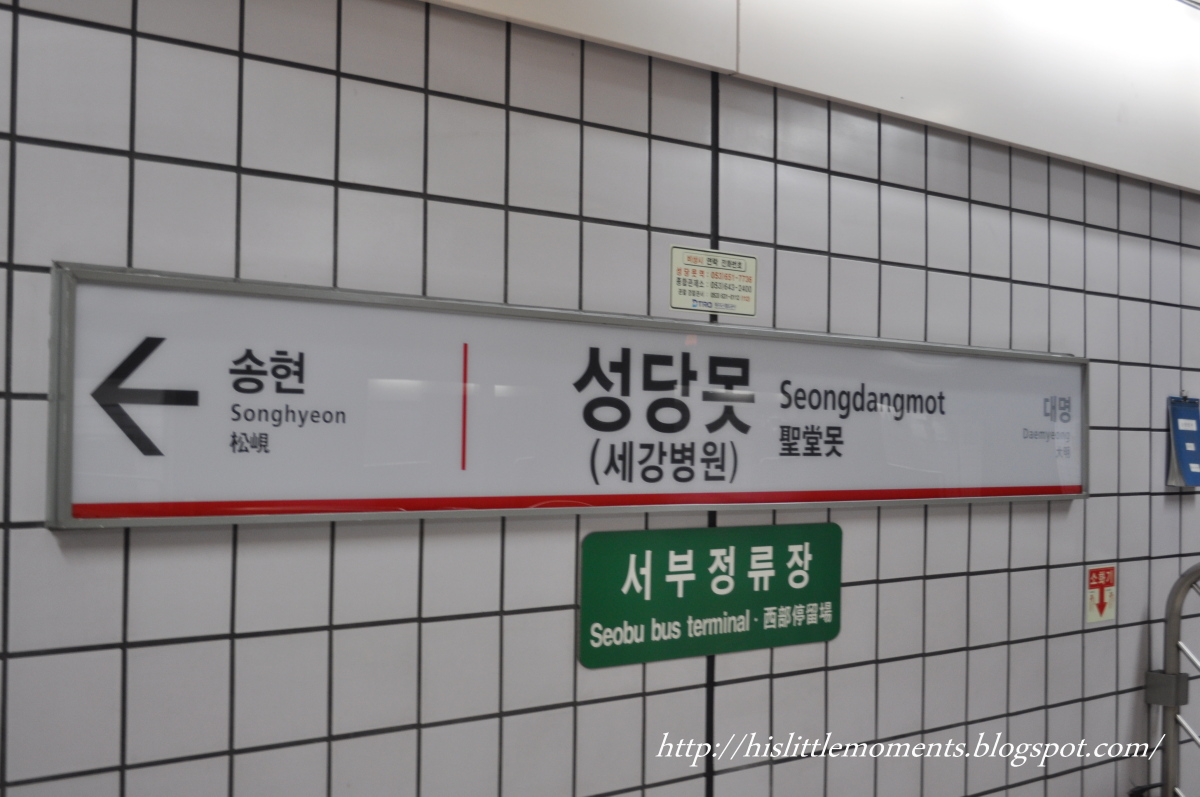
First, get off at Seongdangmot (성당못)

 
Exit here - Exit number 3

 
The bus station is directly next to the exit 


From my university, we took a taxi to Banwoldang Station (반월당), the only station where Line 1 and Line 2 of the Daegu subway intersects. Then, we took Line 1 to Seongdangmot (성당못) and exited the station at Gate 3 (Sobu Bus Terminal - 서부정류장). 

There, bus ticket to Yeosu can be bought (Less than 20,000 Won one way). Travelling by bus was a "butt-wrecking" experience. One Ahjumma (old lady) entered the bus even though all the seats were filled and she pretended to arrange her belongings on the top rack of the bus. 

When the bus driver was halfway on the road, she asked the bus driver whether or not it is possible for her to sit on the floor of the bus. Left with no choice, the bus driver relented. 


I felt like giving her my seat but the 3 hours plus journey scares me off. Along the way, I remembered we stopped at a rest stop and during the rest of the journey, I was sleeping. We arrived at Yeosu around 6 pm and we took a bus (Free!) to the exposition site. 

There will be guides (around bus stops) so it is very easy for tourists visiting the town. My first impression of the town/city (I can't call it a city) was this is a countryside (진짜 시골처럼 ㅋㅋ). Facilities there were bare minimum but food and accommodations were as expensive as in Seoul (maybe because of the exposition).


Evening Pass 

 
Standard Day Pass 

 
Sight from the main entrance gate


We knew beforehand that visiting the Expo for a day was not enough, we quickly bought the entry passes as soon as we reached Yeosu Expo site (2 tickets - 1 for the standard day pass, 33,000 Won and the other is Evening pass, 16,000 Won). So, the journey began. 

As a souvenir, we also bought the "Yeosu Passport" at 5,000 Won each. At every pavilion visited, we can obtain a stamp to be stamped/pasted on the "Passport".

 
Yeosu "Passport"

 
Singapore Pavilion

 
Australia Pavilion! 


On the first day, I visited Singapore, Peru, Thailand, Indonesia, Cambodia, Vietnam, Brunei, Australia (Had my dinner there too), Malaysia (Roti Canai at 7 Dollars? Come on!!! I can get it for less than 0.50 Dollars if I am in Malaysia!!!), Philippines and finally, Russia (Food here is so expensive, more than 20 Dollars for a decent meal). 

 
My Dinner @ Australian Pavilion

 
Malaysian Pavilion 


As it was already late at night, we watched the fountain performance and light-play at the "Big-O". That was the end of our Day 1. After we exited from the site, we searched for place to overnight. Most cheap rooms were already taken and it cost upwards 100 Dollars for a normal room. 

So we bargained and we managed to reduce the it to less than 70 Dollars.

 
"Big-O" fountain show 

 
Look at the crowd! 


My Day 2 was about waking up early and getting to the theme pavilions. As I was the earliest to wake up, (the rest were still sleeping) I managed to visit the aquarium (Lots of people!!! Honestly, if lining up for hours is a cup of tea for you, go for it but if not - skip it! I started to line up at the entrance at 8.00 am and entered the aquarium only at around 9 am.). 


Hyundai Pavilion

 
Bus ticket back to Daegu 


Other pavilions I visited worth mentioning were the Climate and Environment Pavilion and the Korean Pavilion. I visited almost all the international pavilions but had to give few European countries' pavilions a miss. 2 days is certainly not enough to visit all of them. 

Going back was the same and the bus journey (18,200 Won) back was better, everyone was tired so most of us slept until we reached Daegu. Dinner was a miserable Cheese Kim bap (2,000 Won) and red (or black?) bean buns. 


The expo was so-so and personally, I witnessed many people cutting in line (luckily not the younger ones) and it pissed me off at certain point. As an Asian with Asian values, I maintained my calm and respect for elders but...

Monday, May 28, 2012

Daegu: Of Summer, Life, Happiness, Korean Photo Studio and KNU Festival

This will be my last post of the month, exam's nearing and early preparations are essential to achieve my desired results. Now, it is summer in Korea, there aren’t any cherry blossoms to be seen blooming or cool weather to be felt anymore. It is also highly unlikely that I can wear my favourite outer every time I am outdoors.

Goodbye Spring...

Exercising under humid and warm summer weather has become a physically demanding routine. I felt I am now at my peak of physical capability. I used to run 12 km every day. My love for sports and running began after I realized I had grown a lot fatter since arriving to Korea in 2009. 

My weight was 76 kilos and in just less than 2 months, I ballooned to 82 kilos (Argghh)! Then, I felt I need to do something about myself. I started walking, and walking, and finally running. Now, I am 67 kilos but I used to be 64 kilos. What about you? There's nothing to be embarrassed talking about weight. ^^ 

The worst thing about losing weight was I couldn't wear most of my cloths. Every cloth I have now is either new ones or bought after I shed kilos. In Korea, the most common concern for the men was height issue. The taller you are, the better your "status" is. 

However, it's very amusing to see some people who purchased elevator shoe just to look taller. When I see short guys wearing basketball sneakers, high heeled boots or shoes with padding, just to look taller, I can only wish for them to be contented with whatever features they have.

Platform shoe

I am taller than the Korean national height average of 1.74 m but even if I am shorter, I couldn't care less. My height? Ahem, secret. When I was in high school, I always dread going to the school assembly because I felt teachers are always looking at the tall guys first before looking at others. Come on! Isn’t it so obvious? 

So, I learned to discipline myself by paying attention during assembly, this leads to paying full attention in classes and somehow, not liking to be distracted while focusing on a task. Frankly, I am also not very tall but during my "formative" high school years in Malaysia, I was among the "above-average" or "tall" in height. I never knew height was such an important issue until I was in Korea.

The Spiciest bun ever eaten in Korea! 

After living and mingling with the Koreans, I discovered that most of them are generally more sensitive and more concerned about how they present themselves to others - Are they good enough? Are they comparable with others?, etc. This is why Koreans are very obsessed with rankings. 

Rankings among the OECD (Organisation for Economic Co-operation and Development) countries as the most technologically advanced country, ranking on YouTube on the latest pop culture (The K –pop), and the nomination of Jeju Island as the seven natural wonders of the world and so forth. They are very proud and happy.

However, by being too engrossed in the chasing after rankings and material wealth, they do not know how and when to be satisfied with what they had. Not many Koreans would like to be farmer because they always assume farmers earn very little. However, once they obtained high paying jobs, they are still dissatisfied because of the unending monotony of their job. They also work long hours. 

But they are never happy. Yet, they want their children to get high paying jobs like they themselves. How ironic isn’t it?


Recently, I attended a class but instead of normal lesson, we watched a video on a lecture about “Happiness” conducted at Harvard and a short slide on happiness. I was attracted to the slide presentation more than the video. It was about “What is Happiness?”. There are 3 types of happiness. 

The first one is “The Pleasant Life”, it is about being in a place and spending your time doing things you like. The second is “The Good Life”. This means doing something you are good at and when you lose track of time such as spending time with the people you love or your job. Finally, it is “The Meaningful life”.

Lets have a meaningful life... 

This means knowing your strength and using them in the service of something higher than yourself such as volunteer service. There are many occasions whereby I am happy because I am doing things I like, being on special place and helping people. 

When I think of “The Pleasant Life”, I felt I am always happy when I am inside my room, looking at the greenery outside the window just after it rains and eating a variety of cakes - fruitcakes, layer cakes and chocolate cakes. Yummy..

**

In Korea, taking photos is an essential activity for many occasions. 100-day boyfriend-girlfriend anniversary, class picture and even a plain-looking group shot are all taken in a photo studio. In Daegu, I would suggest going to a photo studio at Banwoldang Subway Station (반월당역). It is located at W427 near the Hyundai Departmental Store and opens from 10 am till 9 pm.

PhotoFun - Taking photos is fun? I don't think so..

"Hey, remove that ugly pimples!!!"..


What's next? Photoshop!

This studio is highly recommended because the price is affordable and for around 4~5,000 Won each person, you can get a set of photos. However, my only problem with Korean studios is that they photo shopped most photos all the time! 

Most of the time, they will make a fat guy appearing thinner on photo, a chubby lady suddenly having a coca cola bottle looking slender waist, dark skinned to a fairer skin (Sigh…), and some other basic retouching like removing wrinkles and pimples.

Tadaaa!!! (Don't ask why I had to pose this way... -_-") 

I love and very contented with everything I have.

**

Stalls (주막) selling you-can-get-them-cheaper-elsewhere alcohols and food

From the top of my dormitory, wow! 

KNU festival was held from last Wednesday to Friday, I attended on Wednesday but fell ill on Thursday and was too exhausted for Friday. I slept early but I watched the fireworks display on the most romantic spot in my dormitory. The open space on the highest spot is where you can see stars, moon and sun, if only the girls can enter the guys dormitory… 

You might also like..

Related Posts Plugin for WordPress, Blogger...
"This is not the end. It is not even the beginning of the end. But it is, perhaps, the end of the beginning" ~Winston Churchill~